





|
|
|
|
|
|
|
| |
| Projects | Centers | Courses | Programs | Students | Links | Diversions | Home |
| Bruce Chatwin, George Carlin, and others on "staying and going" | |
 |
On a rather cynical note, humans have not evolved much over the years, and in fact may have devolved over the last 30 years, with greed driving almost all of our actions and beliefs. This opinion is not inconsistent with my general take on human behavior, which derives from observation and a bit of George Carlin and Bruce Chatwin (among many others). George Carlin had a great bit about "stuff". Everyone has stuff (the more, the better, for most of us), and everyone needs a place to put it. Some stuff is hidden, some is advertised, some is simply stored and often forgotten (mainly because we have too much stuff and it was the act of having and not the stuff itself that resulted in the original acquisition). And at times we have to go places (more on that below), and in doing so we of course need to take some of our stuff with us. This creates all sorts of problems as to what to do with that stuff. You take and leave subsets of your stuff as you travel, always certain to make a place for your stuff at each place that you go (perhaps cars are the ultimate stuff, providing a place to stay and a means to go, yin and yang), not to mention a place to keep more of your stuff. In the (real) old days you pretty much left what little stuff you had in your cave, or you'd wear it on your person. This is the part of human behavior that is effectively "nesting". Everyone needs a home, and home is the place where you have your stuff (and not necessarily, as Robert Frost said, "the place where, when you go there, they have to take you in"). So humans have to stay; and humans have to go (so the answer to Joe Strummer and Mick Jones' question "Should I stay or should I go?" is "yes"). Maybe it's to get away from all the stuff accumulating. Chatwin suggested a fundamental human conflict between the urge for going and the urge for staying, referencing nomadic people as continuing an intrinsic part of human evolution (where hunter/gatherers who wandered out of (at least) necessity, often seasonally repeating paths which in turn can define homelands, or songlines). I think that it's a fundamental dichotomy: the need to stay, which secures one's place and belongings (stuff), and the need to roam, which expands one's opportunities to gain resources (more stuff), and to find better nests. So the home (nest) is a fundamental need, that becomes more of an anchor when the home takes on the role of repository for stuff and not just a nesting place. This has been a central role in literature, not the least being Kerouac's "On the Road", although this was, in my opinion, a case of a traveler, perhaps without a formal home, searching (futilely) for a home:
"He was born on the road in the month of July |
 |
I also think that this dichotomy contributes strongly to the automobile culture. One's car is an extension of one's home (and an extension that allows quite a bit of one's stuff to go along). I think that this is why an auto commute will never be equivalent to a commute by a less personal mode. When people board any form of transit, they are not home until they actually reach their house. With a car, one is in an extension of this place as soon as the door is shut -- it's the personal environment of the traveler, within their total control, which can negate the dis-benefits of travel. Perhaps this is where Pat Mokhtarian's ideas on "the positive utility of travel" come in. Despite her reported evidence that people have indicated a desire to travel (commute) even further/longer, I don't believe that this is a conscious desire to accrue more costs (time, money, etc.), nor is it because there is a positive direct utility or travel. I believe that it is because travel is being accomplished simultaneously with a "place-based" activity (the need to stay, with many of the benefits of a place to stay, including control of one's environment). It is this aspect of the observed travel that people derive benefit from, not the travel itself. The travel portion is simply the mechanism that allows the other benefit to accrue. If you were to impose a ride-sharer on the driver, then the desirability of the trip would typically be reduced even though the costs may remain the same (or even decrease, in conventional money terms). Similarly, if you were to offer a sub-place within the home, in lieu of a portion of a trip (or even a longer trip), with a guarantee of sovereignty, I would bet that most would choose to forego the travel (although the travel portion would in the real world have a higher probability of being inviolate versus the sub-place, say a den, home office, or garage). In the past, bars and pubs have provided this benefit to commuters who walked (or maybe took forms of public transit). There is, of course, the overall benefit of "moving", but traditionally, I think, this is derived from the opportunities presented to the traveler while moving. I'm not sure if habitual commuters could derive any benefit similar to what nomadic (often seasonal) wanderers do, given the relative repetition frequencies. There's much more. Travel can also be seen as running away from a place or situation, an avoidance or flight mechanism (but as Bruce Cockburn wrote, those with shadows behind them are at least running toward a light). But staying can also be avoidance. |
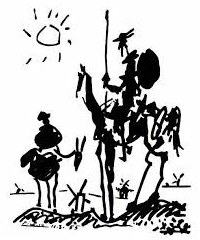 |
Also, real travelers (versus tourists) take little stuff with them, and bring little additional stuff back. Their benefit derives from the journey (the places visited, but also the travel itself). Here there may well be a positive utility for travel, although this form of travel is an actual activity. But real travel is too often overwhelmed by tourist travel where your stuff goes along, and with the need to accumulate souvenirs and to document where you've been. But travel can provide a "place" for the accrual of benefits, while simultaneously providing a level of mobility. "The road is always better than the inn." from Cervantes Don Quixote (1605) I'll conclude with Daniel Dennett in "Consciousness Explained" (Dennett attributes the original mention to Rodolfo Llinas). I find it humorous for both my interest in odd creatures and my distaste for academia. And it also addresses going and staying in a rather humorous manner:
"The juvenile sea squirt wanders through the sea searching for a suitable |
| • The Art of Travel | [ back to top ] |
"The sole cause of man's unhappiness is that he does not know how to stay quietly in his room"
Pascal, Pensées, 136
"We are, perhaps, uniquely among the earth's creatures, the worrying animal.
We worry away our lives, fearing the future, discontent with the present,
unable to take in the idea of dying, unable to sit still." Lewis Thomas
| [ Last modified: 11 March 2006 | terms of use | © mgm ] |